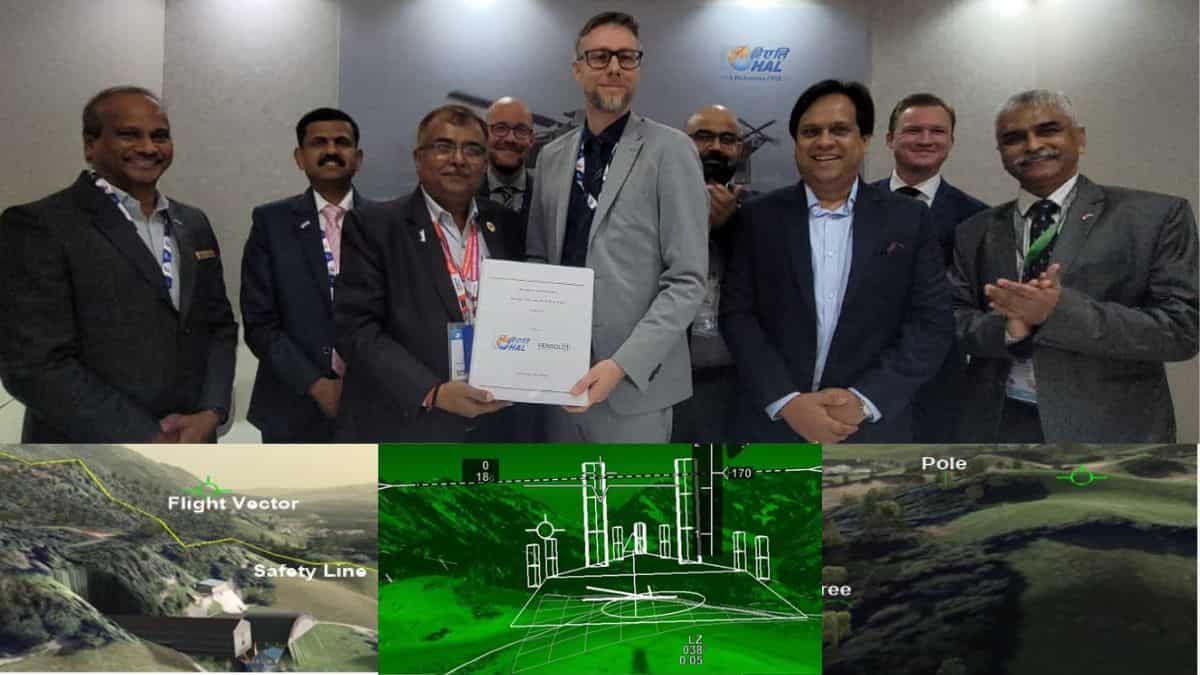
At the Dubai Airshow 2025, progress in a German-design Obstacle Avoidance System (OAS) for military helicopters has given a push to India’s position as a defence manufacturing hub. This comes with the signing of a landmark transfer of technology (ToT) agreement between defence PSU Hindustan Aeronautics Limited (HAL) and HENSOLDT, a German defence-electronics company specialising in sensor systems. Germany’s government holds a 25.1 per cent stake in HENSOLDT.
The need for OAS has emerged from a growing operational imperative. India’s helicopter fleet undertakes missions that range from high-altitude logistics in Ladakh to casualty evacuation in the Northeast and reconnaissance flights along mountainous and forested terrain.
Helicopters flying low over uneven terrain face one of their most serious dangers from obstacles like power lines, cables, towers and wires that disappear in darkness, fog, dust or brownout. These hazards are responsible for a significant share of helicopter losses worldwide, particularly during military low-level missions, night operations, humanitarian flights, and landings in unfamiliar terrain.
Pilots operating under pressure or in degraded visual environments often have only seconds to react, and traditional sensors, especially radar-based systems, struggle to detect very thin objects or wires unless the helicopter approaches them at just the right angle.
The OAS addresses this gap by using LiDAR rather than radar, allowing it to scan ahead with laser precision and detect obstacles far sooner and with far greater accuracy. Official specifications indicate that the LiDAR, based on patented fibre-scanner technology, achieves a detection probability of at least 99.5 per cent within the first second and can identify obstacles at distances exceeding one kilometre.
Because LiDAR uses an extremely small wavelength, it can spot wires as thin as a few microns even when radar, with its larger beam, routinely misses them. The system also detects hazards from any direction of approach, reacts within the first second, and has a proven operational track record with police, EMS and air force fleets. The result is a level of situational awareness that significantly reduces collision risks and provides crews with the confidence to fly safely in conditions that would otherwise be too dangerous.
The agreement announced on November 19 in Dubai is set to allow HAL to manufacture, integrate, and support the LiDAR-based OAS in India using transferred design and intellectual property. It equips Indian military helicopters (such as the Light Combat Helicopter and the Advanced Light Helicopter) with sophisticated flight-safety technology capable of detecting even the thinnest obstacles in degraded visual conditions. It also gives HAL the right to export the system globally, enabling India to develop and own a sovereign, high-end helicopter safety capability.
The new development pathway is consistent with India’s broader effort to embed greater design and systems integration capability into its aerospace ecosystem, an ambition that is becoming increasingly central to defence industrial planning.
It also carries particular relevance for the Uttar Pradesh Defence Industrial Corridor (UPDIC), where HAL’s avionic division in Korwa has been identified as a key facility for the programme’s long-term co-development footprint.
For suppliers across the region, the OAS programme offers potential opportunities in optics, embedded systems, processing hardware and certified aviation components, contributing to a more resilient and specialised supply chain.
Source link