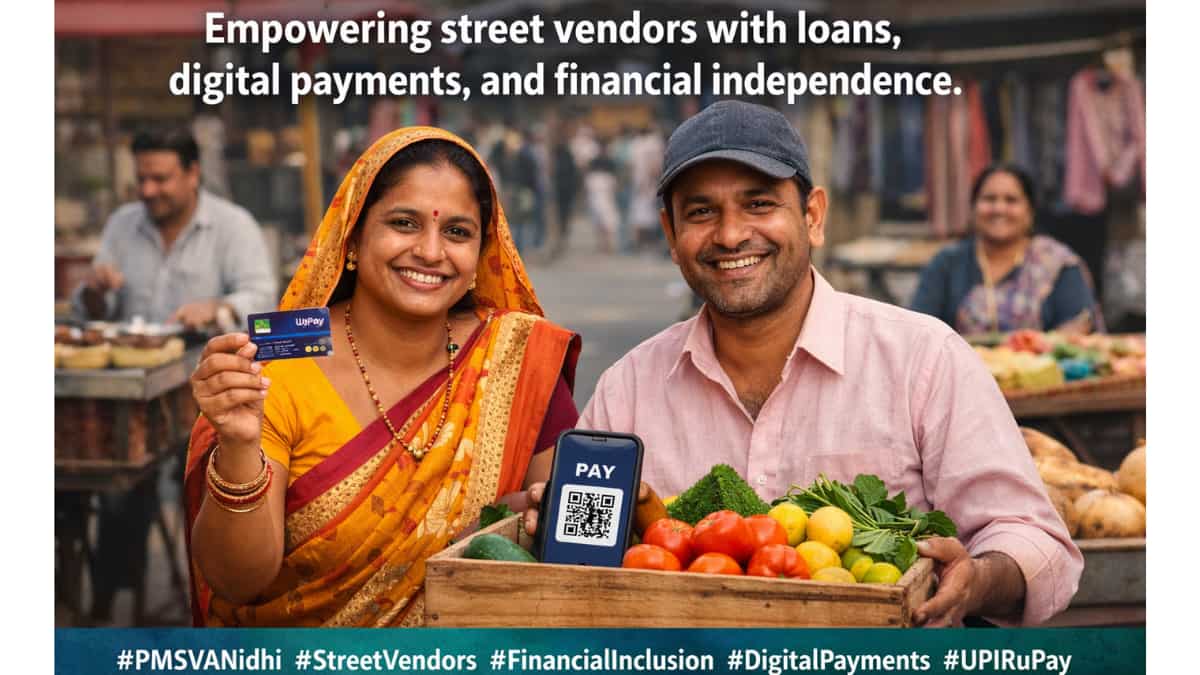
The PM SVANidhi scheme: A government scheme initiated to support urban street vendors by providing them access to small business loans.
The scheme allows vendors to operate their businesses while improving income and achieving financial independence.
The duration of the scheme has been extended until March 2030, including cities, census towns, urban agglomerations and peri-urban areas.
What are loan tranches under PM SVANidhi?
Under the PM SVANidhi scheme, street vendors receive working capital loans through three different loan amounts, known as tranches.
This loan system enables vendors to borrow a smaller amount of money from banks under the PM SVANidhi scheme and repay easily, decreasing the chances of facing financial hardships.
Loan tranches and eligibility
A vendor can request a second loan after making their first loan payment according to schedule, and then become qualified for their third loan after paying off their second loan according to schedule.
A large number of vendors have benefited from this scheme since its launch in 2020. As of 20 January 2026, around 71.57 lakh vendors have received the first tranche loan, 27.28 lakh have availed the second tranche, and 6.61 lakh vendors have accessed the third tranche, as the growing number of vendors shows increasing confidence and active involvement in the program.
The PM SVANidhi program has established UPI-linked RuPay Credit Cards to provide additional support to vendors through its newly organised system.
The credit cards become available to vendors who complete their second loan repayment. The cards assist vendors in solving their immediate business requirements while enabling them to make digital transactions and diminishing their need for cash.
As of 2 February 2026, more than 15,000 people have applied for these credit cards, and 2,479 cards have already been issued.
Evidence of success and growth
The ISB conducted research studies in 2023 and 2025, which showed that the scheme brought beneficial results. The study results show that SVANidhi beneficiaries experienced a 20 per cent increase in their yearly business earnings, which occurred between 2023 and 2025.
The scheme enabled vendors to establish credit histories, which 30 per cent of borrowers used to access official loans.
How has the PM SVANidhi scheme improved access for street vendors?
The PM SVANidhi program now provides street vendors with loan assistance until March 2030, according to its newly established framework.
The scheme has expanded its reach from major cities to include census towns, urban clusters and nearby peri-urban areas through a gradual implementation process. Street vendors will benefit from this expansion because it will create additional job opportunities.
State governments and Urban Local Bodies (ULBs) are responsible for identifying eligible street vendors and encouraging them to apply for the scheme.
The Ministry has established multiple awareness programs to reach more vendors who need coverage. The programs use various media channels, which include radio jingles, TV advertisements and newspaper campaigns.
Local language materials help vendors understand the benefits
States and Union Territories receive local language information materials, which help vendors understand the scheme benefits better. The government conducts regular review meetings with States and UTs and ULBs to monitor development and enhance execution.
The Ministry of Housing and Urban Affairs (MoHUA) organised multiple public events and campaigns to extend its reach to additional participants.
The restructured scheme received approval on 27 August 2025, which led to Lok Kalyan Melas being conducted throughout ULBs from 17 September to 15 October 2025.
The events enabled people to discover the new scheme elements while street vendors obtained assistance with their loan application and digital onboarding work, which resulted in quicker loan approvals.
The special nationwide drive named ‘SVANidhi Sankalp Abhiyan’ operated from 3 November to 2 December 2025. The campaign worked to resolve all pending applications at both the bank and ULB levels while delivering faster benefits to vendors.
How are digital payments encouraged among vendors?
Digital Payment Aggregators (DPAs) partner with ULBs to create digital literacy camps, which teach street vendors about digital payment systems. The camps instruct vendors on how to use digital payment systems.
The vendors receive cashback rewards for their cashless transactions, which enables them to adopt digital payments while they expand their business operations.