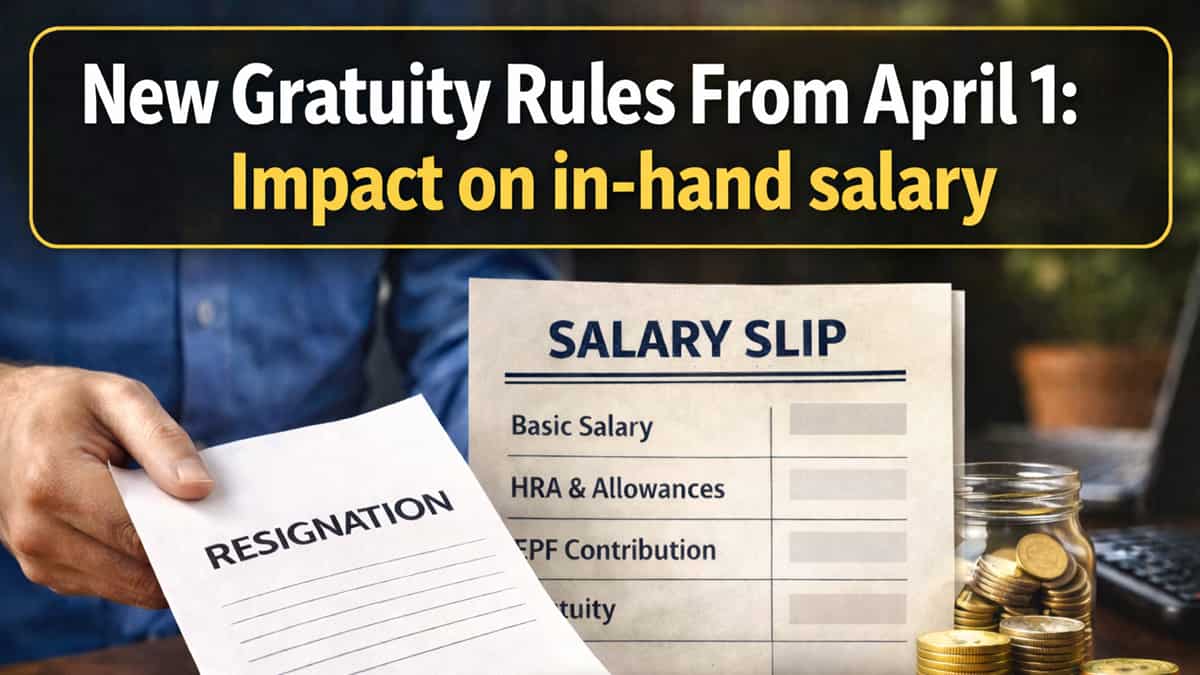
New Gratuity Rules From April 1: India’s gratuity rules have undergone a structural overhaul under the Labour Codes, and the impact is now becoming visible in 2026. While headlines focus on “gratuity after one year”, the deeper shift lies in how salaries are defined and calculated. The new framework not only expands eligibility for certain employees but also increases gratuity payouts by raising the wage base. At the same time, it may reduce monthly in-hand salary due to higher provident fund (PF) contributions. Here is a clear, detailed breakdown of what the new gratuity rules from April 1 mean for your salary, eligibility and long-term savings.
New Gratuity Rules Explained: What changes in salary structure from April 1?
The biggest talking point – gratuity after one year – does not apply to everyone.
Under the new Labour Codes:
- Fixed-term employees (FTEs) qualify for gratuity after completing one year of service
- Contract workers also benefit from similar provisions
- Gig and platform workers are being gradually brought under social security coverage
However, for regular full-time employees, the rule remains unchanged. They still need to complete five years of continuous service to be eligible for gratuity.
This distinction is critical, as much of the public confusion comes from the assumption that the one-year rule applies universally.
50% Wage Rule Impact: Why your gratuity payout may jump up to 66%?
The real game changer is the 50 per cent wage rule.
Under the new definition:
- Basic pay + DA + retaining allowance must be at least 50 per cent of CTC
- Any excess allowances are added back to wages
Earlier, companies kept basic salary low (around 30–40 per cent of CTC) to reduce statutory payouts. Now, they must increase it.
Gratuity is calculated on last drawn wages. A higher basic salary means a significantly higher payout.
In many cases, this shift alone can increase gratuity by up to 66 per cent.
Gratuity Calculation Formula Under New Rules: How higher wages increase payout?
The formula remains unchanged:
Gratuity = (15 ÷ 26) × Last drawn wages × Years of service
What has changed is the wage base.
- Earlier: Lower basic salary — lower gratuity
- Now: Higher basic salary — higher gratuity
Because the last drawn salary is used, the new rules increase payouts across the entire tenure, not just recent years.
Rs 1,00,000 salary example: How much more gratuity you can get now?
A simple example shows the impact clearly:
- Basic salary: Rs 30,000
- Gratuity (5 years): Rs 86,538
- Basic salary: Rs 50,000
- Gratuity (5 years): Rs 1,44,231
Increase in payout: Rs 57,693
For longer tenures, the difference becomes even more significant, often running into lakhs.
Gratuity Eligibility Rules 2026: Who benefits under new Labour Codes?
Yes, for many employees, monthly take-home salary may fall.
- PF is calculated as a percentage of basic salary
- When basic pay rises to meet the 50 per cent rule, PF contributions increase
- Higher deductions reduce monthly in-hand salary if CTC remains unchanged
- Less cash in hand today
- More savings for retirement through PF and gratuity
PF and bonus changes under new Labour Codes
The ripple effect goes beyond gratuity:
While percentages stay the same, the total payout value may rise.
Faster settlement after resignation
Another key change is faster settlement timelines.
- Final dues, including gratuity, are expected to be cleared quickly after exit
- Employers need to be financially prepared to meet obligations without delay
This reduces waiting time for employees and strengthens enforcement of labour rights.
Impact on employers
The new rules significantly increase employer obligations due to two factors:
- Higher wage base → higher gratuity payouts
- Wider eligibility → more employees qualify (especially FTEs and contract workers)
This creates a sharp rise in financial liability, forcing companies to:
- Restructure salary components
- Plan gratuity provisioning more carefully
- Adjust compensation strategies over time
Salary vs Retirement Savings: The real trade-off employees must understand
The new gratuity rules bring a clear trade-off:
- Short term: Lower in-hand salary due to higher deductions
- Long term: Higher gratuity, better PF savings, stronger retirement security
This is not a temporary adjustment but a structural reset in salary design across industries. If you are a salaried employee, you should immediately review:
- Your basic salary as a percentage of CTC
- Changes in PF contribution
- Estimated gratuity payout at exit
- Impact on monthly take-home salary