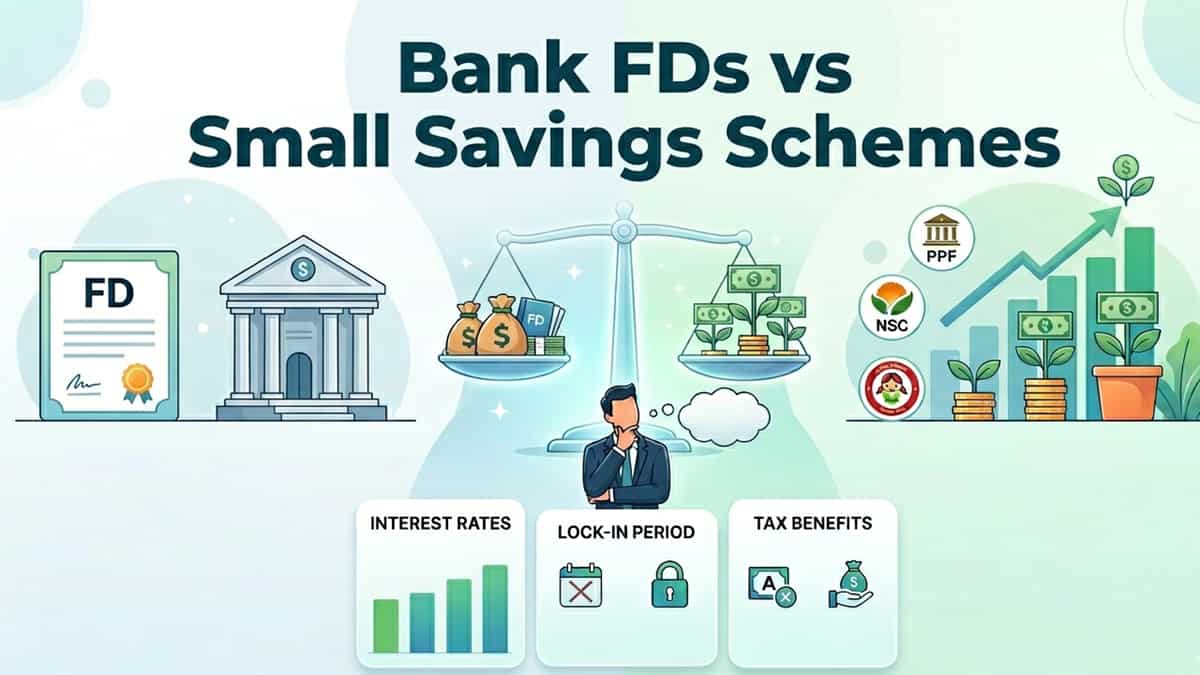
Bank FDs vs Small Savings Schemes: The Centre has kept interest rates on small savings schemes unchanged for the April–June 2026 quarter, marking the eighth straight quarter without any revision. At the same time, bank fixed deposit (FD) rates are hovering between 6.25 per cent and 6.66 per cent, while small savings schemes continue to offer returns of up to 8.2 per cent. For investors, the choice is fairly straightforward but important – whether to go with bank FDs for flexibility or put money into government-backed options such as Public Provident Fund (PPF), National Savings Certificate (NSC) and Sukanya Samriddhi Scheme, which offer higher returns but come with longer lock-in periods. The decision ultimately depends on your time horizon, liquidity needs and tax planning.
Interest rates compared
For most investors, returns remain the primary deciding factor. In April 2026, bank FD interest rates are largely in the range of 6.25 per cent to 6.66 per cent annually.
In comparison, small savings schemes offer a wider and often higher range of returns:
- Sukanya Samriddhi Scheme: 8.2 per cent
- National Savings Certificate: 7.7 per cent
- Kisan Vikas Patra: 7.5 per cent
- Monthly Income Scheme: 7.4 per cent
- Public Provident Fund: 7.1 per cent
- Post Office Savings Deposit: 4 per cent
This makes small savings schemes more attractive on pure return metrics, especially for long-term investors.
Bank FD rates
Leading banks are currently offering the following FD rates:
- State Bank of India: 6.25 per cent
- HDFC Bank: 6.25 per cent
- ICICI Bank: 6.25 per cent
- Kotak Mahindra Bank: 6.50 per cent
- Yes Bank: 6.66 per cent
While these rates are stable and predictable, they generally fall short of the top small savings schemes.
Lock-in period
One of the biggest differences between the two options lies in liquidity.
Bank FDs are relatively flexible. Investors can choose tenures ranging from a few days to several years, and premature withdrawal is allowed, albeit with a penalty.
Small savings schemes, on the other hand, come with stricter lock-in periods:
- NSC: 5 years
- PPF: 15 years
- Sukanya Samriddhi Scheme: till maturity linked to the girl child’s age
This makes them better suited for long-term financial goals rather than short-term parking of funds.
Tax benefits
Tax treatment is another major factor where small savings schemes have an edge.
- Investments in schemes such as PPF, NSC and Sukanya Samriddhi qualify for deductions up to Rs 1.5 lakh under Section 80C of the Income-Tax Act.
- Interest earned on some schemes also enjoys tax advantages, depending on conditions.
In contrast, interest earned on bank FDs is fully taxable as per the investor’s income tax slab. This reduces the effective return, especially for those in higher tax brackets.
Risk and safety
Both bank FDs and small savings schemes are considered low-risk investments.
Small savings schemes are backed by the government, offering a high level of security. Bank FDs are also relatively safe, especially when deposited with large, established banks.
For conservative investors prioritising capital protection, both options remain reliable.
Can you invest in both?
Financial experts often advise against choosing one over the other. Instead, a balanced approach works better.
A mix of FDs and small savings schemes can help:
- Maintain liquidity through FDs
- Lock in higher returns through long-term schemes
- Optimise tax benefits