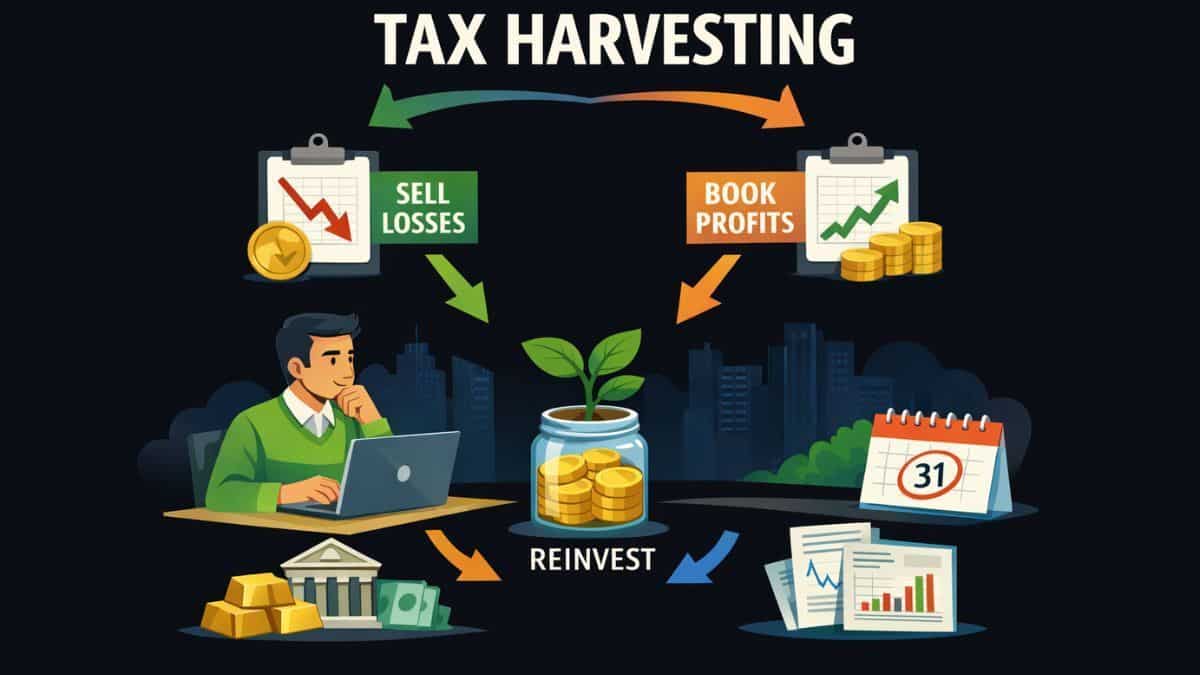
As the financial year-end approaches, many investors are looking for legal ways to lower their tax burden while staying invested for the long term. One effective strategy that often goes unnoticed by retail investors is tax harvesting — a method of booking profits or losses in investments and reinvesting them to reduce capital gains tax.
Explaining the concept, Nitesh Buddhadev, founder of Nimit Consultancy, and Kshitiz Mahajan, CEO and Managing Partner of Complete Circle Wealth, shared how tax harvesting can be used across asset classes such as equity, mutual funds and gold.
What is tax harvesting?
Tax harvesting involves strategically selling investments to realise capital gains or losses and then reinvesting the money. The goal is to use tax exemptions and set-off rules to lower future tax liability without changing long-term investment plans.
Kshitiz Mahajan said that long-term investing should go hand in hand with tax efficiency.
“Long-term investing is important, but making it tax-efficient is equally important. Every year, the government allows a certain amount of long-term capital gains in equity to be tax-free. By redeeming and reinvesting smartly, investors can convert part of their gains into principal and lower future tax,” he explained.
Currently, long-term capital gains (LTCG) on equity above the exemption limit are taxed at 12.5 per cent, while short-term gains are taxed at a higher rate. Using the exemption each year can help investors save a meaningful amount in taxes over time.
How profit booking reduces future tax
Mahajan explained that tax is charged only on the appreciation part of an investment, not on the original amount invested.
“For example, if you invested Rs 5 lakh and the portfolio grows to Rs 7.5 lakh, then Rs 2.5 lakh is capital appreciation. If you redeem part of this gain and reinvest it, the appreciation reduces and the principal increases,” he said.
Over time, this process gradually lowers the portion of the portfolio that is taxable. While the overall portfolio value remains the same, the tax liability reduces in the long run.
Using losses to offset gains
Apart from booking profits, investors can also use losses to reduce tax.
Nitesh Buddhadev explained that many investors see temporary losses in equity due to market fluctuations. By selling these investments and buying them back, the losses become real for tax purposes.
“Many investors have notional losses in equity. If you temporarily sell those investments and buy them back, that loss can be adjusted against capital gains — even across asset classes like gold and equity,” he said.
For instance, if an investor has made profits in gold but is facing losses in equity, booking equity losses can reduce the tax payable on gold gains.
“This is especially useful now, as gold has delivered strong returns while equity markets have seen volatility,” Buddhadev added.
Also Read: From withdrawal rules to pension payments: 16 key EPFO reforms every member should know
Key tax rules to remember
The experts highlighted some important rules related to capital gains:
- Short-term capital loss can be adjusted against both short-term and long-term gains
- Long-term capital loss can be adjusted only against long-term gains
- Losses can be carried forward for up to eight years if not used immediately
- Each SIP investment is treated separately for tax purposes based on its holding period
Who benefits most?
According to Mahajan, tax harvesting works best for retail and middle-income investors.
“For most individuals, saving Rs 15,000 to Rs 20,000 in tax every year may seem small, but when reinvested consistently, it can compound into a large amount over time,” he said.
However, very large portfolios or family offices may not see a major impact because of the scale of their investments.
Timing and reinvestment are important
Both experts cautioned investors not to stay out of the market for too long after redeeming investments.
Buddhadev said tax harvesting is not about predicting market movements.
“The idea is to redeem and reinvest quickly so you don’t miss market movements. The biggest risk is staying out of the market,” he noted.
Mahajan added that investors should be careful during strong market rallies or major events, as missing even a few days of sharp gains could impact returns.
Low awareness among investors
Despite being a legal and effective tax-saving method, tax harvesting is still not widely used in India.
“Only a small percentage of retail investors actually practice this. Many believe it affects compounding, which is not true if reinvested properly,” Buddhadev said.
Both experts advised investors to review their capital gains statements before March 31 each year and consult a tax professional if needed.
Summing up the benefits, Mahajan said, “Money saved in tax is money earned. If used consistently, tax harvesting can quietly add to long-term wealth.”
With the financial year coming to an end, investors who plan smartly can reduce their capital gains tax while keeping their investment goals intact — legally and efficiently.